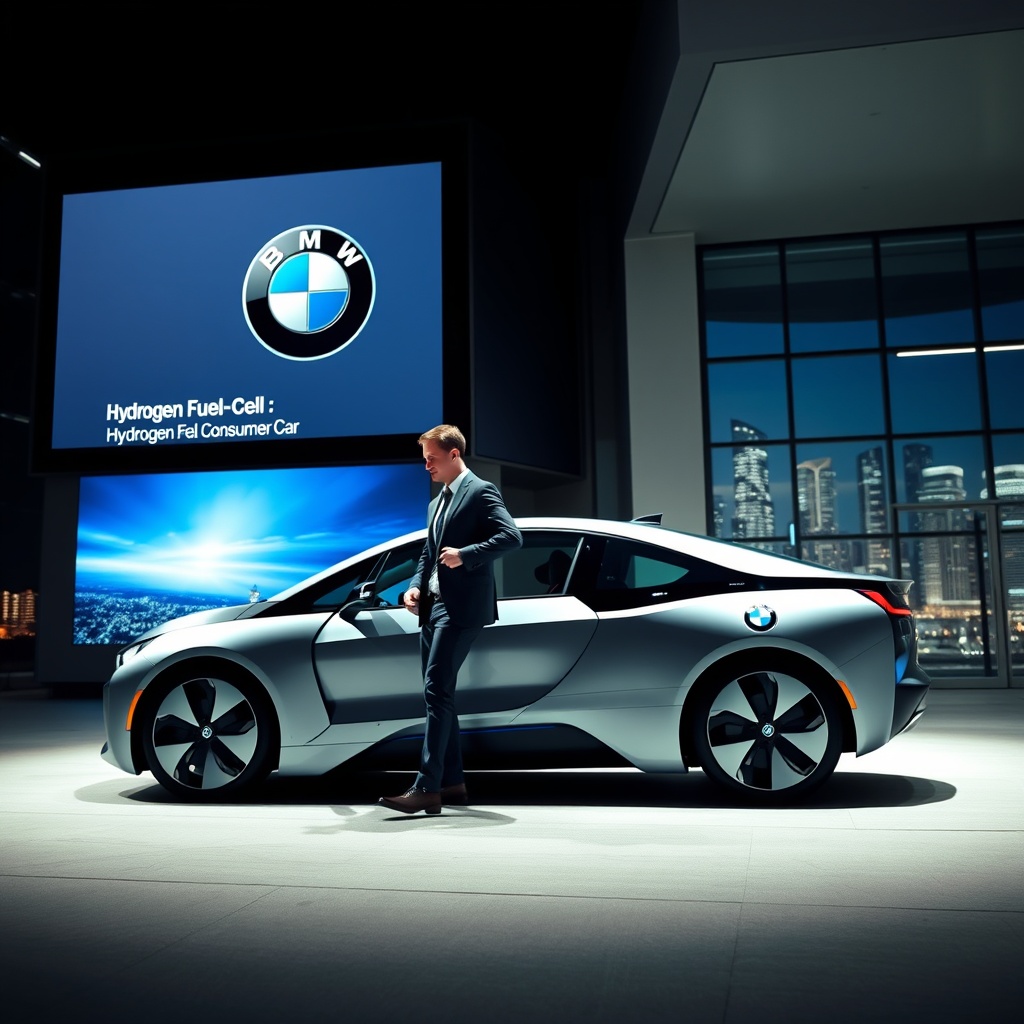
BMW Joins Toyota to Develop Hydrogen Fuel-Cell Consumer Car
In a move that is being hailed as a significant step towards achieving a shift to zero-emissions transportation, German automaker BMW has announced its collaboration with Toyota to develop a hydrogen fuel-cell consumer car for series production in 2028. This announcement comes at a time when the world is increasingly looking towards cleaner energy sources and reduced emissions.
According to Juergen Guldner, general project manager of BMW’s hydrogen technology and vehicle projects, the decision to work on a hydrogen fuel-cell vehicle was made after careful consideration of various options for reducing emissions. “We looked at all available technologies and we realized that hydrogen is an attractive option,” he said in an interview.
Guldner explained that hydrogen vehicles can offer a “best of both worlds” scenario, where customers get the benefits of electric driving with the convenience of refueling like traditional gasoline cars. This, he believes, will be a key selling point for the new technology.
While some experts have expressed concerns about the challenges associated with building out hydrogen infrastructure, Jason Munster, principal and founder of hydrogen consulting firm CleanEpic, agrees that a mix of BEV and hydrogen fuel cell vehicles is more cost-effective and sustainable. However, he notes that the challenges are substantial, including the cost to build out hydrogen infrastructure.
The Challenges Ahead
One of the major hurdles facing the adoption of hydrogen fuel-cell technology is the lack of hydrogen refueling stations. Currently, there are only a handful of such stations in operation around the world, making it difficult for consumers to access this technology. Additionally, the production of hydrogen itself requires energy and resources, which can be a challenge when it comes to sourcing renewable energy.
However, BMW is working on building out an ecosystem that will support the widespread adoption of hydrogen fuel-cell vehicles. In addition to its collaboration with Toyota, the company has been testing a pilot fleet of hydrogen vehicles in over 20 countries for the past 20 months and has received positive feedback so far.
The Future of Transportation
As the world continues to transition towards cleaner energy sources, it is clear that transportation will play a significant role. With the rise of electric vehicles, traditional car manufacturers like BMW are facing a threat to their very existence. However, by investing in hydrogen technology, they may be able to maintain their market share and continue to profit from their existing infrastructure.
The OPEC report predicting continued growth in oil demand through 2050 suggests that the world will still be reliant on fossil fuels for transportation, even if it is slowly transitioning towards cleaner energy sources. In this scenario, BMW’s decision to work with Toyota makes sense as a strategic move to ensure their continued relevance in an industry where they can maintain their existing infrastructure.
Conclusion
While BMW’s announcement of working with Toyota to develop a hydrogen fuel-cell consumer car may seem like a positive step towards achieving zero-emissions transportation, it may also be a clever strategic move to ensure the company’s survival in an industry that is rapidly changing. The OPEC report predicting continued growth in oil demand through 2050 only serves to highlight the complexities of transitioning away from fossil fuels and the need for companies like BMW to adapt quickly to remain relevant.
Related Connection
The announcement from BMW and Toyota on their collaboration to develop a hydrogen fuel-cell consumer car for series production in 2028 seems like a beacon of hope in the fight against climate change. On one hand, this move is seen as a necessary step towards achieving a shift to zero-emissions transportation, offering the benefits of electric driving with the convenience of refueling like traditional gasoline cars.
The fact that BMW is working on building out an ecosystem by testing a pilot fleet of hydrogen vehicles in over 20 countries and partnering with commercial fleet customers to drive demand suggests that they are serious about making this technology a reality. However, as Jason Munster from CleanEpic notes, there are challenges to building out hydrogen infrastructure, including the cost to build it out and the need for hydrogen to be made using renewables.
This highlights the complexities of transitioning away from fossil fuels and towards cleaner energy sources. But what if I were to suggest that BMW’s decision to work with Toyota might not be as altruistic as it seems? What if this collaboration is, in fact, a strategic move to ensure their continued relevance in an industry where electric vehicles are rapidly gaining traction?
Consider the report from OPEC predicting that global oil demand will keep increasing until 2050, with no peak in sight. This is at odds with other major energy agencies like BP and the International Energy Agency (IEA), which expect oil use to peak this decade.
According to OPEC’s forecast, global oil demand is expected to reach 118.9 million barrels per day by 2045, a gain of 2.9 million barrels from last year’s estimate. By 2050, it’s predicted to hit 120.1 million barrels per day. This growth in oil demand can be attributed to several factors, including a stronger economic backdrop and increased vehicle ownership.
Now, let’s connect the dots between BMW’s announcement and OPEC’s report. What if I were to suggest that BMW’s collaboration with Toyota is not just about developing a cleaner fuel source, but also about hedging their bets against an uncertain future?
With the rise of electric vehicles, traditional car manufacturers like BMW are facing a threat to their very existence. By investing in hydrogen technology, they may be able to maintain their market share and continue to profit from their existing infrastructure.
Furthermore, consider OPEC’s forecast of increased oil demand through 2050. This suggests that the world will still be reliant on fossil fuels for transportation, even if it is slowly transitioning towards cleaner energy sources. In this scenario, BMW’s decision to work with Toyota makes sense as a strategic move to ensure their continued relevance in an industry where they can maintain their existing infrastructure.
In conclusion, while BMW’s announcement of working with Toyota to develop a hydrogen fuel-cell consumer car may seem like a positive step towards achieving zero-emissions transportation, it may also be a clever strategic move to ensure the company’s survival in an industry that is rapidly changing. The OPEC report predicting continued growth in oil demand through 2050 only serves to highlight the complexities of transitioning away from fossil fuels and the need for companies like BMW to adapt quickly to remain relevant.
Word Count: 1046




Congratulations to @Toyota on their new hydrogen fuel-cell partnership with @BMW. It’s a game-changer for our planet! But, let’s be real, what if BMW is just hedging its bets against the electric car revolution? After all, OPEC predicts we’ll still be burning fossil fuels through 2050. Is this the beginning of a new era or just a clever survival strategy? #HydrogenFuelCells #ElectricCars
Emily brings up some astute points here, but I’m not sure if BMW’s partnership with Toyota is more about embracing a new technology or simply trying to stay relevant in a shifting landscape – especially considering the recent news that Mattel had to pull their Wicked Dolls from shelves due to some rather…adult packaging mistakes. It just goes to show how quickly our world is changing, and I’m curious to see how this partnership will play out in the long run.
I don’t think that’s a coincidence. What if this collaboration is, in fact, a strategic move by both companies to slow down the transition to electric vehicles? With OPEC predicting continued growth in oil demand through 2050, it’s clear that there will still be a strong market for fossil fuels even as we shift towards cleaner energy sources. By investing in hydrogen technology, BMW and Toyota may be able to maintain their existing infrastructure and continue to profit from the sale of internal combustion engines, at least in the short term.
Wow, what a thrilling development! BMW joining forces with Toyota to develop a hydrogen fuel-cell consumer car is a game-changer in the fight against climate change. But what if I told you that this collaboration might be more than just a altruistic move? What if it’s actually a strategic attempt by BMW to hedge their bets against an uncertain future, where electric vehicles are rapidly gaining traction?
Read the full article here to see how OPEC’s forecast of increased oil demand through 2050 might be a major factor in BMW’s decision-making. Are we witnessing a clever ploy by BMW to maintain their market share and continue profiting from their existing infrastructure, or is this truly a beacon of hope for a cleaner future? The suspense is killing me!
https://tersel.eu/north-america/weighing-the-pros-and-cons-of-an-interest-rate-cut/ (It’s like, totally relevant to our discussion, trust me).
But I digress. If BMW is indeed trying to maintain their market share, doesn’t that imply they’re not exactly betting on the future of climate-friendly transportation? Am I missing something here?
I mean, Aaliyah might be onto something – what if this hydrogen fuel-cell car thingy isn’t just a PR stunt to look good in front of the EPA, but actually a desperate attempt by BMW to stay relevant in a world where EVs are taking over?
Aaliyah, your mind-bending theories are sending shivers down my spine! I couldn’t agree more that this partnership might be a calculated move by BMW to safeguard their interests in an uncertain market. And speaking of uncertainty, have you heard about Meta’s bold decision to ditch fact checkers for community notes? It’s a high-risk, high-reward move that could either revolutionize the way we consume information or plunge us into a abyss of misinformation! As someone who’s been following this space closely, I’m both thrilled and terrified by the prospect of X-style community notes taking over – what do you think Aaliyah, will it be a beacon of hope for free speech or a recipe for disaster?
I remember the days when driving a car was synonymous with freedom and adventure. The rumble of the engine, the smell of gasoline, and the open road stretching out before you – it was an experience like no other. But now, as we hurtle towards a future where hydrogen fuel-cell cars are the norm, I can’t help but feel a pang of nostalgia for those bygone days.
What’s your take on this shift to cleaner energy? Do you think BMW and Toyota’s partnership will be a game-changer for the industry, or is it just a desperate attempt to stay relevant in an era where electric vehicles are rapidly gaining traction?
I’m not sure what’s more astonishing, Comulate’s $20M raise or the author’s lack of skepticism when it comes to the insurance industry’s role in rebuilding after unimaginable disasters. It’s like they’re trying to convince us that everything will be okay just because some companies are working on it. Meanwhile, I’d rather take a closer look at the article “The Mystery of New Zealand’s Rarest Whale” (https://tersel.eu/australia/the-mystery-of-new-zealands-rarest-whale/) and wonder if the real mystery is how we’re still using fossil fuels when we claim to care about climate change.
I’m grateful for the thought-provoking discussion sparked by Sawyer and Amara’s comments on the BMW-Toyota partnership. As someone who’s been following the automotive industry’s shift towards cleaner energy, I have to respectfully disagree with their perspectives. Today’s news about the Trump administration upholding regional commitments in Asia, despite its high-decibel rhetoric, reminds me that even in unexpected ways, progress can be made. As a long-time advocate for environmental sustainability and a fan of innovative technologies, I believe that collaborations like the BMW-Toyota partnership can drive meaningful change. With my background in environmental science and a passion for sustainable living, I’m excited to see the potential of hydrogen fuel-cell cars in reducing our carbon footprint. I’d like to ask, what do you think is the most significant hurdle that the automotive industry needs to overcome in order to make hydrogen fuel-cell cars a viable alternative to traditional vehicles?