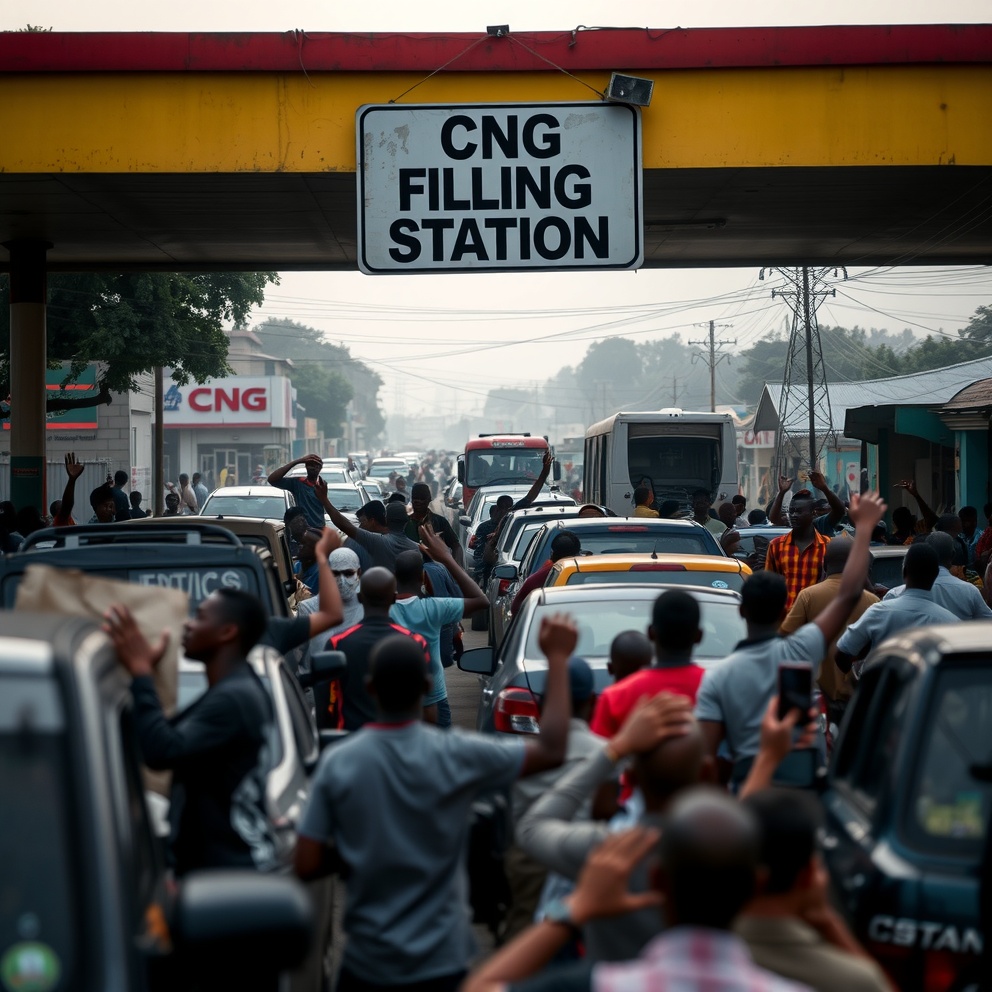
Tanzania’s CNG Dream Hits Roadblock: Filling Stations in Short Supply
The Rise of Compressed Natural Gas in Tanzania
Tanzania, a country located in the heart of East Africa, has been at the forefront of a revolution in vehicle fuel. For years, the country has been embracing compressed natural gas (CNG) as an alternative to traditional petrol and diesel fuels. And for good reason – CNG is not only relatively cheap but also environmentally friendly, emitting significantly fewer pollutants than its fossil fuel counterparts.
The story of Tanzania’s CNG movement began several years ago, when the government announced a plan to transition the country to natural gas-based transportation. The goal was ambitious: to have nearly all vehicles running on CNG by the middle of this century. And while progress has been slow, the growth of this movement has been undeniable.
For those who have converted their vehicles to run on CNG, the benefits are clear. Not only do they save money on fuel costs, but they also reduce their carbon footprint and contribute to a cleaner environment. However, for every motorist who has made the switch, there are countless others who remain hesitant.
The Problem of Filling Stations
So why have so many motorist been slow to adopt CNG? The answer is simple: there just aren’t enough filling stations. In Dar es Salaam, the largest city in Tanzania, there are only four places where drivers can fill up their tanks with compressed natural gas. This has led to long queues and frustration among users.
One motorist who has been affected by this shortage is Samuel Amos Irube, a taxi owner who converted his vehicle to run on CNG several years ago. “I spend more time waiting at filling stations than earning money,” he laments. “Every time I want to refuel, I have to wait for at least three hours.” Mr. Irube’s experience is not unique – many other motorists face similar frustrations.
The Government’s Response
Despite these challenges, the government remains committed to rolling out more infrastructure and encouraging private investors to get involved in the development of CNG filling stations. In fact, officials are optimistic about the growth potential of this industry and see it as a key component of Tanzania’s energy security strategy.
Taqa Arabia, an Egyptian company that runs a filling station near Dar es Salaam airport, is one such investor. The country manager of Taqa Arabia sees the growing demand for CNG as a “positive sign” and plans to build more stations in the coming months. “We are committed to supporting Tanzania’s energy security strategy,” he says.
A Central Solution
To alleviate the pressure on filling stations and reduce congestion at existing sites, the government is exploring various solutions. One of these involves building a central CNG “mother station” in Dar es Salaam that will supply gas to several surrounding filling stations.
Another initiative is the acquisition of mobile CNG units that can be deployed to remote areas, providing much-needed refueling facilities for motorists who may not have access to traditional filling stations. While these solutions are welcome, they do little to address the root problem: a lack of infrastructure investment in the development of new filling stations.
Conclusion
In conclusion, Tanzania’s CNG dream is facing a major roadblock: a shortage of filling stations. Despite the benefits of this cleaner-burning fuel, motorists continue to face frustration and long queues when refueling. While there are positive signs that CNG use is developing in Tanzania, it will require significant investment in infrastructure to support its growth.
As the country looks to meet its ambitious targets for CNG adoption by the middle of this century, policymakers must prioritize the development of new filling stations and invest in innovative solutions like mobile gas units. Only then can the full potential of compressed natural gas be unleashed in Tanzania – and the dreams of motorists like Samuel Amos Irube finally become a reality.
Key Statistics
- Tanzania has large reserves of gas under the sea, making CNG a relatively cheap option for motorists.
- There are currently only four places in Dar es Salaam where drivers can fill up with CNG.
- The government aims to have near-total adoption of CNG by the middle of this century.
Impact on the Future
The growth of Tanzania’s CNG movement has significant implications for the country’s energy security strategy and its commitment to reducing pollution. If successful, it will pave the way for a cleaner, more sustainable transportation sector that benefits both motorists and the environment.
However, if the current lack of infrastructure investment continues unabated, it could hinder progress and limit the growth potential of this industry. As policymakers look to meet their ambitious targets for CNG adoption, they must prioritize the development of new filling stations and invest in innovative solutions like mobile gas units. Only then can Tanzania truly unlock the full potential of compressed natural gas.






Pound rebounds as business confidence sinks amid Brexit uncertainty, Trump’s plans, and a stronger dollar weighing on gold and oil prices. This kind of volatility can have far-reaching consequences, and Tanzania needs a more diversified energy mix.
Your idea of hybrid CNG vehicles is intriguing, but it raises questions about investment priorities. As you said, should we focus on building more filling stations or investing in research and development for these new solutions? I think there’s a middle ground to be explored here.
As someone who’s worked with sustainable energy projects, I’ve seen how innovation can solve infrastructure problems. But we also need to consider the social and economic impacts of such changes. Tanzania has limited resources; it needs to balance its ambitions with practicality.
Let’s not get too carried away with new ideas, Seth. We need a more nuanced approach that takes into account the complexities of this situation. Perhaps we can explore hybrid CNG vehicles as part of a broader energy strategy that includes diversifying fuel sources and investing in renewable energy.
What a delightful article by the author. I must say, I’m impressed by their enthusiasm for Tanzania’s CNG dream. As someone who grew up in Dar es Salaam during the 90s, I have fond memories of watching compressed natural gas vehicles roll down the streets, their quiet hum a refreshing change from the cacophony of car horns that plague our city today. However, I do agree with Seth’s assessment that infrastructure development can be a major obstacle, but I also think he raises an interesting point about our obsession with filling stations.
You see, during my childhood, we didn’t have all these fancy electric vehicles or hybrid cars. We had CNG buses and taxis that ran on compressed natural gas, and they were incredibly efficient. They didn’t produce any emissions, and they were so quiet it was like having a ghostly fleet roaming the streets. Of course, those were simpler times, but I think we’ve gotten too caught up in chasing after new technology without considering the potential of existing solutions.
As Seth points out, even car manufacturers are starting to question the feasibility of a purely electric future. Perhaps we should take a cue from them and explore alternative solutions like hybrid CNG vehicles. It’s not a pipe dream; it’s a feasible solution for the near future. And I think it’s worth considering whether we should focus on building more filling stations or invest in research and development for hybrid CNG vehicles.
So, let’s not get bogged down by the status quo. Let’s think outside the box (or filling station) and explore new solutions that can help us unlock the full potential of compressed natural gas. As Seth so eloquently puts it, why choose? Let’s have our cake and eat it too!
The conversation around Tanzania’s CNG dream is heating up, but let’s take a step back and assess the situation – I mean, have you all seen the state of the roads in Dar es Salaam? It’s like a parking lot out there! Nora makes an excellent point about considering alternative solutions, but Seth’s suggestion to ditch traditional filling stations altogether seems too radical, even for me who’s had my fair share of fueling up at those dodgy roadside stations. Steven raises valid concerns about investment priorities, and I’m curious, Summer, have you spoken to the government about providing incentives for private investors like yourself to build new filling stations? Meanwhile, Seth, I’m not sure if you’ve noticed, but your comment made me question my own obsession with hybrid CNG vehicles – maybe it’s time to trade in my gas-guzzler for something a little more eco-friendly.
Destiny, I love your point about Tanzania’s CNG dream needing more than just hype infrastructure like Dar es Salaam’s crumbling roads and sparse filling stations are the real hurdles here. You’re absolutely right that Seth’s radical ideas (ditching traditional stations?) sound like they’re straight out of a sci-fi novel. But Steven? He’s got a wild card too, linking global economic chaos to Tanzania’s energy needs. I mean, how do you even begin balancing Brexit uncertainty with building a CNG network?
And here’s where the wolf DNA in your chihuahua study hits me: maybe Tanzania needs a hybrid approach part practical infrastructure (like filling stations), part bold innovation (R&D for hybrids). Destiny, have you talked to Steven about this? Could a mix of old and new be the real “genetic” key to making CNG work?
P.S. If your dog’s got wolf DNA, maybe Tanzania’s energy plan needs some wild ideas too just not ones that ignore the road to Dar es Salaam.
I recently stumbled upon this insightful article on ‘AI Innovations from Google’ via a friend’s recommendation on social media check it out here for the full 2025-09-17 discussion. Reflecting on Nora and Steven’s takes amid the buzz around Google’s AI-driven energy optimizations, I generally align with their pragmatic vibes Nora’s nod to hybrid CNG vehicles from her Dar es Salaam memories feels nostalgically efficient, letting us blend old-school reliability with low emissions without ditching infrastructure dreams entirely.
Yet, as I mull over my own hesitations about resource-strapped rollouts, Steven’s caution on market chaos like Brexit ripples hits home, though I moderately push back: shouldn’t we lean harder into Nora’s “cake and eat it” hybrids before over-diversifying into renewables that might strain Tanzania’s grid? What do you think could Google’s AI models, as detailed in the article, simulate how Nora’s CNG nostalgia meshes with Steven’s diversified energy push to outpace real-world infrastructure headaches?