image
Mazda’s Rotary Revival: 2025-27 Wankel as Hybrid/EV Range Extender
Introduction: A Legendary Engine’s Second Act
In the electrified landscape of 2025, where battery-electric vehicles (EVs) dominate headlines and hybrids bridge the gap to full electrification, Mazda is poised to resurrect one of automotive history’s most polarizing innovations: the Wankel rotary engine. No longer the quirky heart of pure internal combustion sports cars like the RX-7 and RX-8, Mazda’s revived rotary unveiled in prototype form at the 2025 Japan Mobility Show is engineered exclusively as a range extender or series-hybrid generator. This isn’t nostalgia; it’s a calculated pivot to hybrid architectures amid EV infrastructure hurdles, stringent emissions rules, and the rise of carbon-neutral fuels.
Mazda’s February 2024 formation of a 36-engineer Rotary Engine Development Group stocked with veterans from the RX-7 and RX-8 eras signaled intent. By November 2025, two prototypes emerged: a single-rotor unit (≈830 cc equivalent, 50–100 hp) and a twin-rotor powerhouse (≈1.6 L equivalent, 250–380 hp peak). CEO Masahiro Moro and CTO Ryuichi Umeshita have declared the tech production-ready, hinging only on business viability. Decisions loom in 2026, with 2027 launches eyed for models like an MX-30 R-EV successor. This deep dive dissects the technology, strategy, competition, risks, and far-reaching implications of the rotary’s hybrid renaissance.
Historical Context: From Felix Wankel’s Dream to Mazda’s Obsession
The Wankel rotary, patented by German engineer Felix Wankel in 1929 and first commercialized by NSU in the 1960s, captivated with its compact size, high-revving nature, and smoothness. Unlike pistons sliding in cylinders, the Wankel’s triangular rotor spins inside an epitrochoidal housing, completing three power strokes per revolution delivering vibration-free power. Mazda adopted it in 1967 with the Cosmo Sport, scaling up to icons like the RX-7 (1978–2002) and RX-8 (2003–2012).
Yet, the rotary’s flaws poor fuel efficiency, high oil consumption, apex seal wear, and emissions woes led to its demise. The RX-8’s 13B-MSP managed 29–31% thermal efficiency but guzzled oil (0.5–1.0 L/1000 km) and barely met Euro 4 standards. Mazda idled rotary production in 2012 amid tightening regulations, repurposing a single-rotor variant as a generator in the MX-30 EV (2020). Parallels abound: just as piston engines evolved through turbocharging and direct injection in the 1970s oil crises, today’s rotary leverages electrification and advanced materials, echoing Audi’s brief 2010s flirtation with rotary range extenders (canceled amid EV skepticism).
This revival mirrors broader industry cycles. In the 1990s, hybrids like the Toyota Prius redefined efficiency; now, as EV adoption stalls (global sales growth slowed to 20% in 2025 per IEA data), range extenders resurface much like diesel-hybrids did post-2008 fuel spikes.
Where We Stand – November 2025: Prototypes to Production
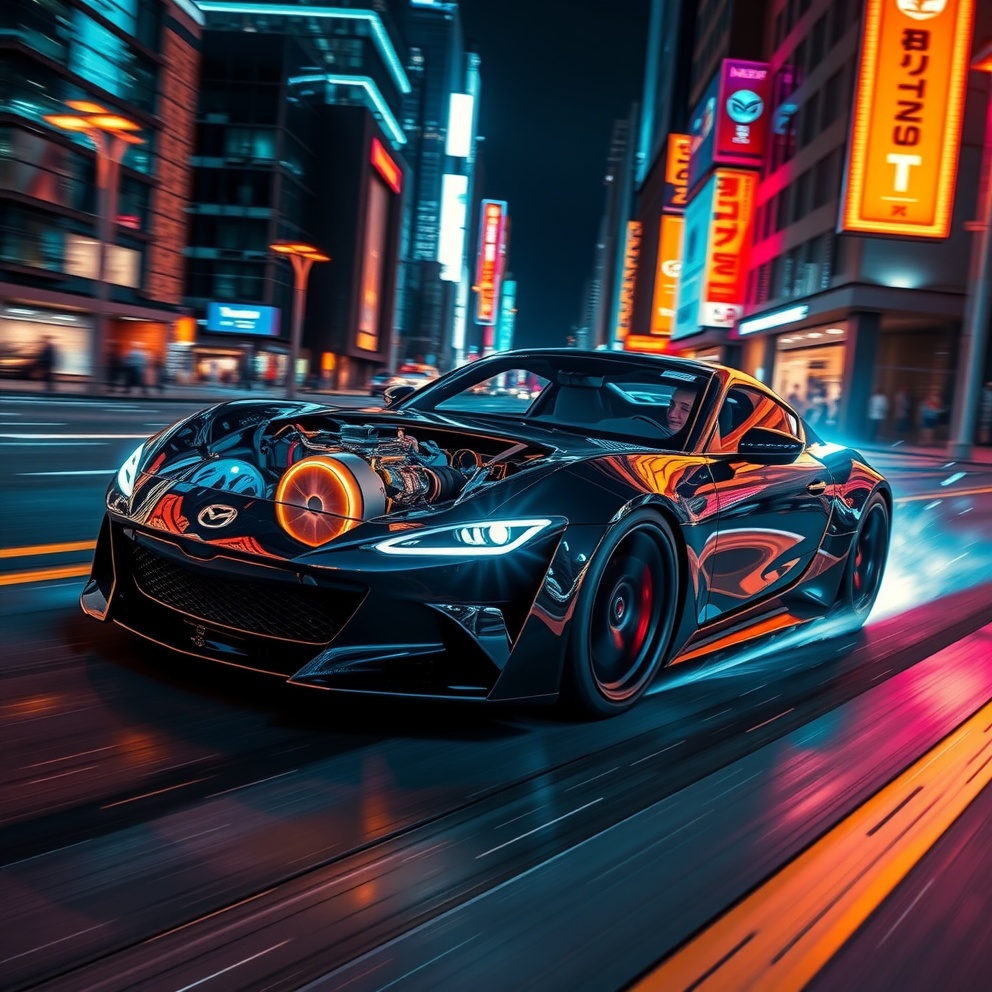
Mazda’s 2025 prototypes mark a pivotal shift. The single-rotor suits compact applications, while the twin-rotor powers the Vision X-Coupe concept, featuring an experimental CO₂ capture system. Both integrate with 48V or 400V electric motors on the eccentric shaft, prioritizing generator duty over propulsion. Production hinges on 2026 economics, with Moro emphasizing, “The engine is technically ready today.”
Rumored timelines target 2027 debuts, aligning with Mazda’s multi-solution powertrain strategy hybrids, PHEVs, and EVs to meet Japan’s carbon-neutral roadmap and EU 2035 bans on new ICE sales (e-fuels permitted). From a market perspective, this counters EV range anxiety: U.S. DOE data shows 40% of drivers exceed 300 miles weekly, where pure EVs falter without fast-charging grids.
Technical Evolution: Revolutionizing the Wankel
Mazda’s engineering feats address historical Achilles’ heels, boosting viability as a hybrid component.
| Feature | Old RX-8 13B-MSP (2003–2012) | New 2025–2027 Rotary | Improvement | ||
|---|---|---|---|---|---|
| Thermal efficiency | ~29–31% | 42–45% (steady-state) | +45–55% | ||
| Apex seal material | Carbon + metal | TCP chrome/steel | 3–4× life | ||
| Oil consumption | 0.5–1.0 L/1000 km | <0.15 L/1000 km | –85% | ||
| Specific power | 120 hp/L | 180–220 hp/L (twin-rotor) | +50–80% | ||
| Weight (twin-rotor dry) | 128 kg | ≈105 kg | –18% | ||
| Emissions compliance | Euro 4 / Tier 2 Bin 5 | Euro 7 / SULEV30 ready | Modern | ||
| Fuel flexibility | Gasoline only | Gasoline, E100, synthetic, H₂, NH₃ | Versatile |
Breakthroughs include direct side-port injection with variable timing (production-first for rotaries), ceramic-lined cooling in hotspots, and Transplant Coating Process (TCP) seals blending chrome and steel for unmatched durability. In generator mode, the rotary idles at 3500–4500 rpm its sweet spot yielding 3.5–4.5 L/100 km in series hybrids. The Vision X-Coupe’s CO₂ scrubber captures 90% of exhaust, enabling net-negative emissions with biofuels, a regulatory masterstroke.
From an engineering lens, this rivals piston engines: thermal efficiency now matches Toyota’s Dynamic Force mills, but with superior power-to-weight.
Powertrain Architectures: The Rotary’s New Roles
Mazda deploys the rotary across hybrid paradigms, eschewing standalone ICE.
A. Series Hybrid / Range-Extender EV
Primary focus: rotary generates power for a rear e-axle (à la Nissan e-Power). With 15–35 kWh batteries, expect 600–1000 km range. Ideal for urban MX-30 updates.
B. Parallel Hybrid (Iconic SP / RX Successor)
Midship twin-rotor links via clutch to a multi-speed transmission, augmented by P1/P2/P4 e-motors. Targets 350–450 hp, <4s 0–100 km/h, 150–200 km EV range.
C. Plug-in with CO₂ Capture
Vision X-Coupe previews net-zero ops, hedging 2035+ mandates.
These setups exploit the rotary’s packaging (compact, lightweight) and NVH (near-silent at fixed RPMs).
Competitive Landscape: Standing Tall Against Rivals
Mazda’s rotary excels in niches EVs and rivals can’t touch.
| Technology | Energy Density (System) | Packaging | NVH | Cost (2027 est.) | Carbon-Neutral Ready? | ||
|---|---|---|---|---|---|---|---|
| Mazda new rotary | 1.1–1.3 kWh/kg | ★★★★★ | ★★★★★ | $120–160/kW | Yes (H₂, e-fuels) | ||
| Toyota 1.5L Dynamic Force | 0.9–1.0 kWh/kg | ★★★ | ★★★★ | $80–100/kW | e-fuels only | ||
| BMW 0.65L twin (i3 REx) | 0.85 kWh/kg | ★★★★ | ★★★ | $180–220/kW | No | ||
| Nissan e-Power 1.5L | 1.0 kWh/kg | ★★★ | ★★★★ | $90–110/kW | e-fuels only | ||
| Hydrogen fuel cell (Toyota) | 1.3–1.5 kWh/kg | ★★ | ★★★★★ | $300+/kW | Yes |
Analysis: Rotary leads in density, space, and refinement, trailing only on upfront cost. It shines in carbon rules EU’s 2035 e-fuel loophole, California’s ZEV credits positioning Mazda ahead of piston-extender peers. Versus fuel cells, it’s cheaper and more packageable until H₂ infrastructure matures.
Potential Vehicles and Rollout Timeline
| Vehicle (Rumored) | Architecture | Launch | System Power | EV Range | Total Range | ||
|---|---|---|---|---|---|---|---|
| MX-30 R-EV Gen 2 | Series REx | 2026–27 | 140–170 hp | 150–200 km | 700+ km | ||
| Iconic SP (RX-9?) | Parallel Hybrid | 2027–28 | 370–450 hp | 150–200 km | 800+ km | ||
| Mazda6/CX-60 PHEV | Mild Series Hybrid | 2028+ | 250–300 hp | 80–100 km | 900 km | ||
| Toyota GR Co-Dev (Speculated) | Shared Rotary Module | 2028–29 | 400+ hp | 150 km | 800 km |
This lineup could revitalize Mazda’s sports image while padding volume via crossovers.
Risks, Challenges, and Mitigation Strategies
No revival is risk-free. Apex seals falter in H₂ mode (testing ongoing); twin-rotor costs 30–40% exceed 4-cylinders; rotary mechanics are scarce. Fuel supply lags synthetic e-fuels cost 3–5x gasoline in 2025 (per BloombergNEF). Cannibalization threatens Miata sales. Mazda counters with modular design for scalability and partnerships (Toyota rumors persist).
Future Impacts: Speculating the Ripple Effects
Technological: Validates range extenders as EV stopgaps, spurring rivals (BMW, Nissan) to revisit micros. Could normalize multi-fuel hybrids, accelerating e-fuel adoption projections show prices halving by 2030 with mandates.
Market: Boosts Mazda’s premium halo (RX revival = 20–30% brand uplift, per analyst models). Targets underserved segments: long-haul drivers, weak-grid regions (Asia, rural U.S.), where EVs grew <10% in 2025. Globally, hybrids claim 40% of sales by 2030 (IEA), with rotaries carving a niche. Regulatory/Environmental: CO₂ capture + e-fuels enable compliance in “zero-emission” regimes, pressuring pure-EV lobbies. If scaled, cuts reliance on battery minerals (lithium demand surges 40% yearly, straining supply).
Cultural: Preserves rotary lore, inspiring enthusiasts amid ICE decline. Parallels Prius’s hybridization of Toyotas could birth a “rotary renaissance” in aftermarket tuning.
Speculative Downsides: If e-fuels flop or batteries cheapen (to <$80/kWh by 2030), rotaries niche-ify. Geopolitics matter: H₂ mandates in Japan/EU favor it, but U.S. subsidies tilt EV.
Conclusion: The Wankel Endures in a Hybrid World
Mazda’s 2025–2027 rotary isn’t defying EVs it’s complementing them, solving range, refueling, and soul deficits. After six decades of peaks and troughs, the Wankel finds purpose as the ultimate hybrid booster: compact, efficient, carbon-flexible. In a 2030 landscape of gridlocked electrification, it could redefine “soulful” performance, proving legends adapt. The Wankel was never dead it was waiting for hybrids to revive it.